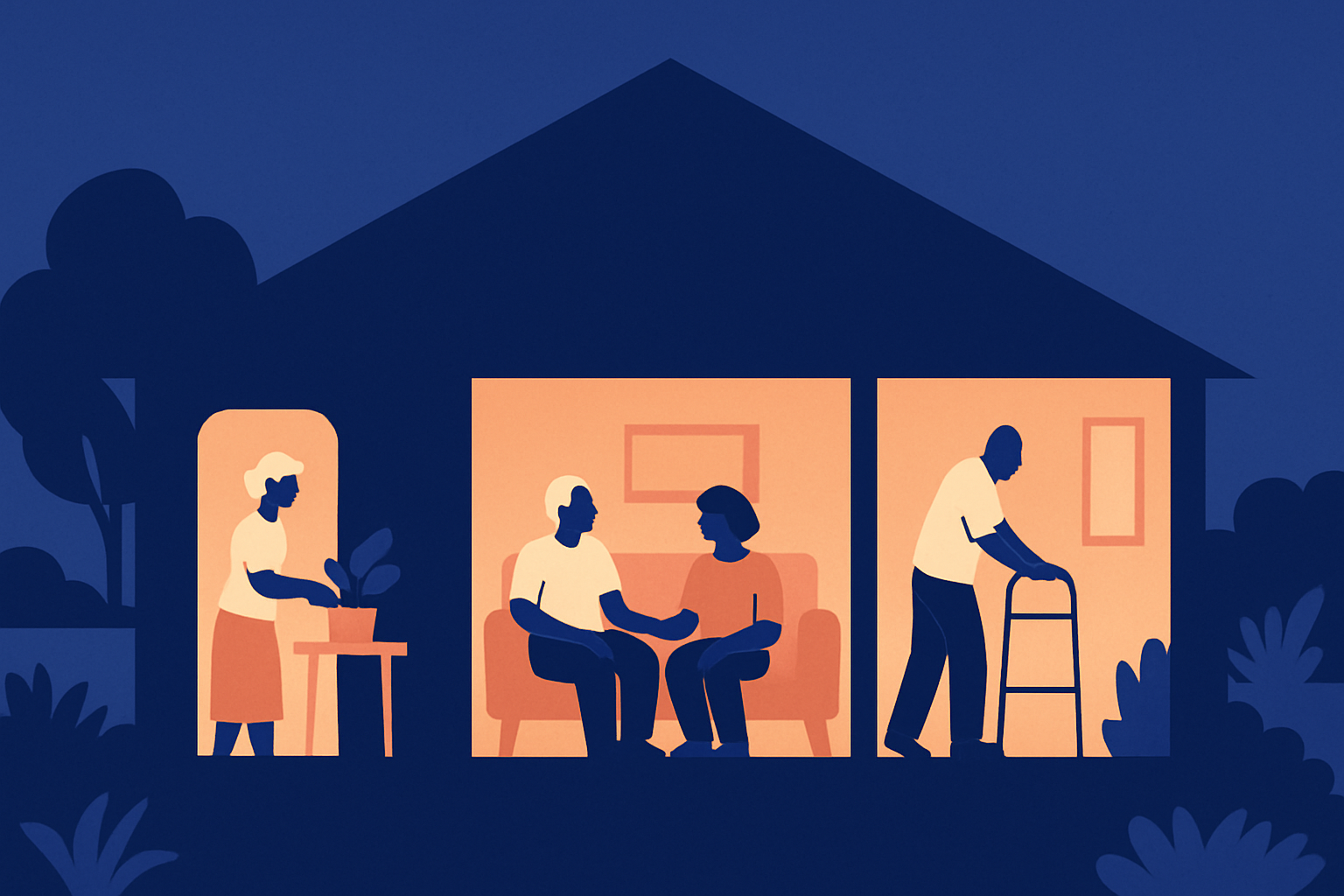
The question rarely arrives as a single question. It arrives as a stair your mother does not want to climb anymore, or a hospital bill that sat unopened for three weeks, or a moment in the kitchen when your father stands still in the middle of the room and does not know what he came in for. Underneath each of those moments is the same housing decision: stay in the home you have known for forty years, or move while you still have the energy to make the move on your own terms.
This guide is the decision, in order. Plain language, no industry jargon, no preference for one answer. Aging in place and moving are not two separate decisions; they are two sides of the same one, and the families that decide well are the ones who weigh both at the same table. Ten sections — what aging in place actually means and costs, when it is the right call, when moving is, the home-modification checklist room by room, the conversation to have first, how to choose between independent living, assisted living, and a continuing-care community, what a Senior Move Manager does, the three-month senior-move timeline, what is different about selling a long-held family home, and the templates that hold the rest together.
TL;DR: Stay or move is one decision, not two. Aging in place often costs more than families estimate once home modifications and in-home help are priced honestly; moving often costs less than families fear once the equity in the long-held home is on the table. Run the home-modification checklist before you commit either way. Have the right-sizing conversation calmly and in advance, not after a crisis. If you move, the realistic timeline is twelve to sixteen weeks, with a Senior Move Manager doing the work that exhausts families. The right answer is the one your parent helps choose with eyes open — not the one delivered to them in a hospital discharge meeting.
What does "aging in place" actually mean — and what does it cost?
Aging in place, in the plainest version, means continuing to live in your own home as you grow older, with whatever modifications, services, and support are needed to do so safely. The phrase is older than the marketing around it — AARP has tracked the preference for decades, and surveys consistently find that about three in four older Americans say they want to stay in their current home as they age. The number is real. The cost of doing it well is the part that rarely makes the headline.
An honest budget includes more than the mortgage. Home modifications run a wide range — a few hundred dollars for grab bars and a shower bench, several thousand for a no-step entry or a stair lift, twenty thousand and up for a full main-floor bathroom remodel. In-home help is the other column families underestimate: a daily home-health aide at typical hourly rates adds up quickly, and overnight or live-in care multiplies it again. Two costs almost never appear in the spreadsheet — the unpaid family caregiver hours and the cost of the unmade move, when a home that fits a 68-year-old no longer fits an 84-year-old and the decision gets made in a hospital corridor instead of at a kitchen table.
For the longer treatment of how to do aging in place safely once the decision is made — the room-by-room safety walk, the basics families do first, and the larger projects that come later — see our companion guide on aging in place: what it means and how to do it safely.
When is aging in place the right choice?
Aging in place is often the right answer, and it is the right answer most clearly when four conditions hold at once. The first is a home whose bones already fit, or could fit with modest investment — a one-level layout, a full bath on the main floor, a manageable yard. A two-story Cape that has not been touched since 1972 is not impossible to modify, but families who pretend it is identical to a one-story ranch end up disappointed in both directions.
The second is a parent whose social life is genuinely tied to the neighborhood — the book group, the church across the street, the neighbor who has been bringing in the mail since the 1990s. These are the actual fabric of well-being that institutional care often spends a year trying to recreate. The third is a care plan that scales: the family has thought through what happens at each stage — a fall, a hospital stay, a dementia diagnosis, the death of a spouse — and has named the resources for each. Without that scaling plan, aging in place often becomes a crisis-response plan in disguise.
The fourth is a budget that covers the truth, not the brochure — modifications, in-home care projected at the level needed in five years, the property maintenance an older homeowner is no longer doing themselves, and a contingency. When the four conditions line up, aging in place is the right call. The families that name them out loud arrive at it deliberately rather than by default.
When is moving the better call? Five clear signals

Moving is often the better call, and the families who recognize the signal early enough to move on their own terms — instead of after a crisis decides for them — are not abandoning aging in place. They are choosing the version of aging in place that happens in a smaller, safer, more social home. Five signals show up in the families I work with most often.
- The home no longer matches the bodyA two-story house with the only full bath upstairs, a long unlit driveway in a region with real winters, a kitchen that requires reaching overhead — when modifications would cost more than a year of senior-community rent, the equation has tipped.
- The social map has thinnedThe closest friends have moved or died, the church changed denominations, the bridge group folded. A community that was once the reason to stay can quietly become the reason to leave.
- The home maintenance has shifted from hobby to burdenThe lawn that took an hour in 2010 takes a Saturday in 2026. The gutters have not been cleaned in three years. The water heater goes and no one in the family knows the plumber's number. When the house is consuming attention the household no longer has, the house is winning.
- Caregiver burnout is no longer hypotheticalA spouse or an adult child is providing daily care and has not had a real day off in months. Moving into a community where meals, housekeeping, and some level of care are included is often less expensive than the in-home equivalent — and dramatically less expensive than the loss of the caregiver.
- A medical event has put the timeline in the openA hospital discharge, a new diagnosis, the death of a spouse. These are the moments when a calm move is still possible if the family acts in months, not in days. The crisis-room version of this conversation rarely produces a good move.
None of these signals on its own forces a move. Two or three of them together is when the families I have walked through this say, in retrospect, “We knew.” The right time to move is usually a year or two before the family thinks it is — early enough for the older adult to choose the community, pack their own boxes, and arrive on their own feet.
The home-modification checklist: room by room
Whether the decision lands on staying or moving, an honest home-modification walk is the same first step. For families staying, it becomes the project list. For families moving, it becomes the realism check — most of these items reappear in the next home anyway, and pricing them out makes the cost comparison real. Walk the house in the order the older adult actually uses it: entry, living areas, bathrooms, bedroom, kitchen, laundry, basement, and outside.
- Entry and walkwaysA no-step entry or a gentle ramp; outdoor lighting that turns on at dusk; a sturdy handrail on every step; a level landing wide enough for a walker. The first ten feet of arriving home are where many falls happen.
- Living areasClear paths at least 36 inches wide; loose rugs removed or taped; cords routed out of walking paths; a sturdy chair with arms to push up from; lamps with reachable switches or a smart-plug schedule.
- BathroomsGrab bars by the toilet and in the shower (anchored into studs, not drywall); a curbless shower or a tub bench with a handheld showerhead; non-slip flooring; a raised toilet seat if helpful; a nightlight that runs continuously.
- BedroomA bed at a height the older adult can sit on without a drop or a climb; a nightstand within arm's reach with a lamp, a phone, a glass of water, and the medication-list page; a clear path to the bathroom with a motion-sensor nightlight along the way.
- KitchenDaily-use items between waist and shoulder height; a step stool retired or replaced with a stable grab-step; lever-style faucet handles; a stove with front-mounted controls or an automatic shut-off device. Many fire departments will do a free home-safety visit.
- Stairs and second floorA sturdy railing on both sides; high-contrast tape on the first and last step; a stair lift if the second floor must remain in use; a plan for sleeping on the main floor after a hospital stay even if only for two weeks.
- Outside and emergencyHouse numbers visible from the street at night; a "Knox box" or lockbox for first responders if the family wants one; a clear path to the mailbox; a snow-removal plan that does not depend on the older adult. A laminated emergency-info page on the fridge — diagnoses, medications, primary doctor, named local contact, allergies.
When the modification list is significant, the cost of doing it well often comes out close to a year or two of senior-community fees. The AARP HomeFit Guide is the most useful free starting reference for prioritizing the list, and many states offer aging-in-place tax credits or HUD-funded home-modification programs. Even when the answer is to stay, the audit is worth the evening it takes to do. For the full safety walk, see our companion guide on aging in place: what it means and how to do it safely.
The right-sizing conversation: how to talk to a parent about moving
Most family arguments about moving are not really about the move. They are about what the move represents — a loss of control, an admission that something has changed, a fear that the children are deciding for the parent. The conversation works dramatically better when it starts a year before the move is needed, in the living room, with a cup of tea, and not in a hospital corridor.
Start with curiosity, not a proposal. Ask what your parent has been thinking about lately — about the stairs, about winters, about the house feeling bigger or smaller than it used to. The first conversation is for listening, not for solving. Many older adults have been quietly turning this question over for months and are relieved when someone else opens the door without pushing them through it.
Use facts, not feelings, as the spine of the second conversation. The cost of a senior community. The cost of one year of the modifications the home would need. The equity in the current home. The hours of family help each week, with a number on it. When the numbers are visible, the decision stops being a referendum on the parent's competence and becomes a household-management problem the family is solving together. The older adult is still the one who chooses; the family is the one offering information.
Three sentences to avoid. "You have to." "It is time." "We have already decided." Each one ends the conversation, often for months. The sentence that opens the conversation back up is some version of "Help me understand what would make this feel like your decision." The honest answer is usually a short list, and most items on that list are easier to give than the family expects — to keep the dog, to bring the dining room chairs, to be near a particular friend, to have a window that faces east. Treat that list as a contract. It is.
Choosing between independent living, assisted living, and CCRC

The senior-living vocabulary is its own dialect, and most of the confusion families navigate is just naming things accurately. Independent living is housing for older adults who do not need help with daily tasks but want the meals, the maintenance, the social calendar, and the security of a community. Assisted living adds personal care — help with bathing, dressing, medication management, and other activities of daily living — usually billed in tiers based on the level of help needed. A continuing-care retirement community, or CCRC (sometimes called a “life plan community”), bundles independent living, assisted living, memory care, and skilled nursing on one campus, with the contract structure handling transitions between levels as needs change.
Independent living suits an older adult who is active, social, and done with home maintenance — closer to an apartment with a calendar than to a care facility. Assisted living suits an older adult who needs help with two or three activities of daily living and wants community alongside that help. A CCRC suits a family who can afford the entrance fee and wants the certainty that the next stage of care happens without a second move.
Compare contracts the way you would compare insurance policies, not the way you would compare apartments. Ask for the full fee schedule, including the entry fee, the monthly fee, the level-of-care add-ons, the rate-increase history for the last five years, and the policy when private resources run down. Ask what happens if your parent's needs grow beyond what the community offers. Ask for the most recent state survey or inspection report — most state health-department websites publish these — and read it before the second visit. A community that hesitates to share the survey is telling you something important.
What a Senior Move Manager does — and when to hire one
A Senior Move Manager is the professional families call when the move itself is the hardest part. The National Association of Senior Move Managers (NASMM) credentials the field; member firms specialize in floor-planning the new space, sorting forty years of belongings, coordinating donation and sale, scheduling movers, and unpacking the new home so the first night is recognizable rather than overwhelming. Done well, it is the difference between a calm move and a traumatic one.
When to hire one. The clearest signal is volume — a long-held home with a lifetime of belongings is rarely sortable in a weekend. The second is distance — long-distance adult children cannot project-manage a move from two time zones away. The third is a tight timeline driven by an event: a hospital discharge moving to an assisted-living move-in, a sale that closes before the new home is ready, a spouse's death that has changed the plan overnight.
How to find one. The NASMM directory lists credentialed members by service area; most offer a free in-home consultation. Ask about the credential, years in business, references from similar families, and liability and bonding insurance. Ask how they price — hourly, by project, or flat-fee — and whether they coordinate with the real-estate agent, the auction house, and the donation truck. The best Senior Move Managers will gently push back when something has been underestimated, which is part of what families are paying for.
What it costs. Engagements range from a small hourly downsize-in-place project to several thousand dollars for a full move with sorting, packing, coordination, and unpacking. Long-term-care insurance occasionally covers a portion when the move is to assisted living; most families pay privately. The honest comparison is not against doing it yourself for free — it is against the value of the weeks of family time and the avoided injuries the professional prevents.
The senior move timeline: 3 months, 30 days, the day-of
A planned senior move is dramatically less stressful than an unplanned one, and the difference is mostly in the calendar. Twelve to sixteen weeks is the realistic timeline for a well-run move — long enough to sort thoughtfully, short enough to keep the project moving. The work falls into three windows.
- Three months out — decide and designConfirm the destination (the deposit, the contract, the move-in date). Walk the new floor plan with measurements of the furniture coming with you. Choose what stays, what goes to family, what is donated, what is sold. Book the Senior Move Manager and the moving company. Notify the post office, the bank, the doctors, and the insurance carriers of the move-in date.
- Two months out — sort and placeRoom by room, with help, decide each item once. Family heirlooms tagged for the right adult child or grandchild. Donations to one or two organizations the parent cares about. The estate sale, the auction, or the consignment scheduled. The "keep" pile fits the new floor plan, not a wish.
- One month out — book the tradesConfirm movers, donation pickup, and estate-sale dates. Address-change paperwork in motion. Utilities scheduled to transfer or shut off. Final medical and pharmacy address updates. A walk through the new home with the Senior Move Manager to confirm the placement of furniture, lamps, and a few familiar objects on the first day.
- Two weeks out — pack with intentionA "first-night" box prepared by the family for the new home — the medications, the phone charger, the kettle, the favorite mug, the first day's outfit, the family photos for the dresser. The boxes labeled by destination room and by what they hold, in plain English, not codes.
- Move day — keep the parent in the calm roomOn move day itself, many Senior Move Managers recommend the older adult is not in the empty house — they are at a friend's home, at the new community having lunch, or with a family member doing something normal. The team executes the move; the family meets the parent at the new home in the early evening with the bed made, the lamps lit, the photos on the dresser, and a meal waiting.
- First two weeks — settle and revisitMost missing items surface within ten days. A short follow-up from the Senior Move Manager closes the project — hang the last picture, confirm the routines work. The first month is for becoming local: the new doctor, the grocery store, the neighbor across the hall.
Selling the family home: what is different about a senior real-estate sale

A long-held family home is rarely a typical real-estate transaction. The house has been owned for decades; the deferred maintenance is real; the original owner may be moving for the first time since 1978; and the emotional weight of the sale is enormous. A small but growing number of real-estate agents hold the Seniors Real Estate Specialist (SRES) designation from the National Association of Realtors, which signals additional training in the senior-relocation context. The credential is not magic, but agents who have done many of these sales know the rhythm — they are patient with the timeline, they coordinate with the Senior Move Manager, and they do not pressure a vulnerable owner into a hurried close.
Three pieces are different from a typical sale. The capital-gains math: a primary residence held for decades may carry significant unrealized gain, and the IRS Section 121 exclusion ($250,000 single / $500,000 married filing jointly) is a meaningful planning tool — coordinate with the parent's CPA before listing. The estate and Medicaid implications: if Medicaid planning is on the table, the timing interacts with the look-back period, and the elder-law attorney needs to be in early. The emotional timeline: many older sellers benefit from staging that keeps a few familiar objects in place until the open houses begin, rather than a fully empty house from day one.
Two sequencing notes. First, do the home inspection before listing if the home has long-deferred maintenance — knowing what is there gives the family the option of pricing it in rather than negotiating after offers. Second, coordinate the closing date with the move-in date at the new community; a brief overlap is worth the carrying cost, and a back-to-back close is one of the most stressful sequences a senior move can produce.
For families navigating a move directly from a hospital discharge — when the housing decision has collapsed into the same calendar as the discharge plan — the 48-hour hospital discharge plan is the parallel guide. And when the move is to an assisted-living community in particular, our companion post on helping a loved one transition to assisted living walks through the emotional side of the move-in week.
Tools, templates, and what to read next
A handful of one-page templates carry most of the housing decision. None of them need an app or a subscription. A “stay vs. move” worksheet — modifications and projected in-home care on the left, senior-community costs and home equity on the right, with the family-time line that is usually missing from the spreadsheet. A “keep / give / donate / sell” sheet for each room, used during the three-month sort. A “first-night” box checklist for the new home. A “where the papers live” note that survives the move. And the home-modification audit, room by room, kept on a clipboard while you walk through it together.
For the broader pillar — every guide in this series as it ships — see the Aging in Place & Moving topic hub. For the longer treatment of the safety walk once the decision is to stay, aging in place: what it means and how to do it safely is the natural next read.
A note on what helps: Aging Sidekick is a planning and organization tool. We do not list real estate, sell furniture, or sign moving contracts on your family’s behalf. What we do is take the fifteen-minute voice conversation about the housing decision and write back the plan a sibling can pick up cold — the modification audit, the family-meeting agenda, the senior-move timeline, the list of questions to bring to a Senior Move Manager. Free to start. We complement, not replace, the real-estate, legal, and move professionals in your family’s life.
About the author: Cyndie Taylor, NASMM — Senior Home Coach (Indianapolis), Certified Senior Housing Professional, Aging in Place Specialist, and Senior Move Manager. Cyndie also writes at taylormademoves.com.
Run a 3-minute home safety audit
Walk through your parent's home one room at a time — kitchen, bathroom, bedroom, stairs — and Aging Sidekick flags the fall-prevention changes that matter most. Free, no signup needed for the audit itself.
Start the safety auditSee the full Aging Sidekick plan →Sources
- AARP — HomeFit Guide (the room-by-room home-modification reference for older adults)
- Centers for Disease Control and Prevention (CDC) — Older Adult Falls Prevention (STEADI)
- U.S. Department of Housing and Urban Development (HUD) — Aging in Place housing resources
- National Association of Senior Move Managers (NASMM) — member directory and consumer resources
- National Institute on Aging — Aging in Place: Growing Older at Home
- National Association of Realtors — Seniors Real Estate Specialist (SRES) overview